
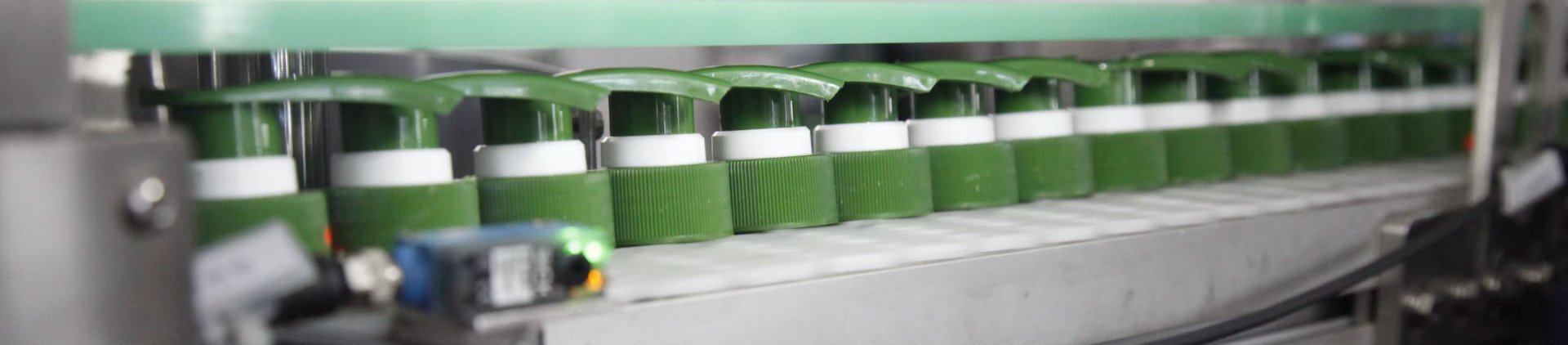
A pump cap capping machine for lotion and shampoo bottles should be selected around the complete package, not only the cap diameter. The pump collar, actuator, dip tube, bottle neck, bottle stability and final dispenser direction can all change the required machine configuration.
The first buying decision is whether the pump will be placed manually or fed automatically. After that, the project can be matched to a dedicated pump-cap tightening station, a servo rotary capping machine or a filling-and-capping line review.
The practical answer
Choose manual pump placement with automatic tightening when pump formats change often, dip tubes are difficult to control or the final package has not been standardized.
Evaluate automatic pump feeding when the same pump family is used repeatedly and representative closures can be sorted, transferred and inserted reliably during testing.
Consider a servo rotary configuration when the main bottle and pump formats are stable enough for dedicated handling parts and a continuous capping process.
Jump to:Package Check|Pump Placement|Machine Choice|Sample Test|Pump Direction|Filling Check|Inquiry List|FAQ
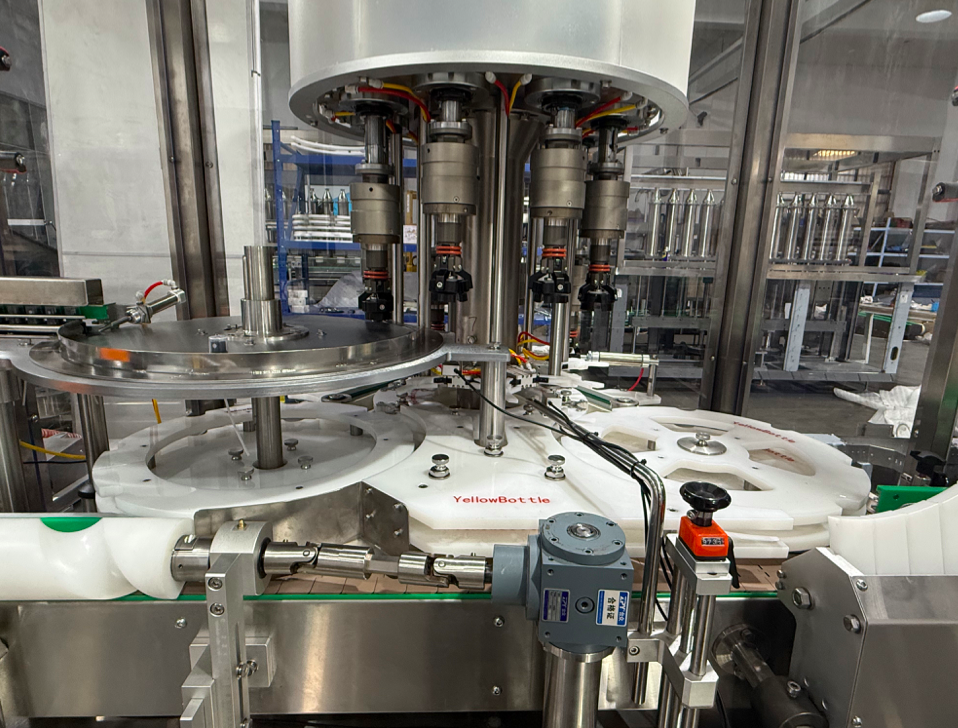
The final machine should be reviewed with the real bottle, threaded pump collar and production-length dip tube.
| View Pump Cap Capping Machine | Discuss Sample Testing |
How to Select a Pump Cap Capping Machine for Lotion and Shampoo Bottles
“Lotion bottle” and “shampoo bottle” describe the product category, but they do not define the equipment. Two packages containing similar liquids may use different bottle walls, neck finishes, pump shapes and tube lengths. Those differences can change how the bottle is held and how the pump is introduced to the neck.
Review these four package details before discussing machine speed or automation level.
1. Liquid behavior
Is the neck clean when the bottle reaches the capper?
Lotion and conditioner may string after nozzle cut-off. Shampoo, body wash and liquid soap may foam or drip depending on the formula and filling method. Product around the neck can interfere with thread engagement, reduce grip and leave an untidy finished package.
2. Bottle stability
Can the filled bottle remain centered?
Tall, narrow or lightweight bottles may sway when the tube enters or when the capping head applies downward force. Soft containers may also deform if the holding method is too aggressive. Filled samples are more useful than empty display bottles for this check.
3. Dip-tube behavior
Does the tube enter without bending or catching?
A long or flexible tube can touch the bottle shoulder, catch the neck edge or push the pump into a tilted position. The tube used for testing should have the same length and flexibility as the production closure.
4. Finished direction
Must the dispenser face the front label?
Some packages only need the pump securely tightened in its locked shipping position. Others require the actuator to face a label, tray or carton direction. Direction control should be stated before the machine concept is approved because it is not the same function as ordinary tightening.
| Application | Main point to check | Useful samples or information |
|---|---|---|
| Lotion and conditioner | Stringing, neck residue, bottle-wall stiffness and collar grip. | Filled bottles, liquid-flow video and final pump samples. |
| Shampoo and body wash | Foam, tall-bottle support, conveyor movement and tube entry. | Filled weight, bottle drawing and production-length tubes. |
| Liquid soap and hand wash | Retail appearance, shipping-lock position and possible front direction. | Labeled bottle, direction requirement and accepted tolerance. |
| Several bottle formats | Changeover range, different holding points and different pump heights. | Complete format list and target output for each important package. |
Selection rule: a cap that falls within a stated diameter range is not automatically compatible. The pump head, threaded collar, tube and bottle must work together during placement and tightening.
Manual Placement or Automatic Pump Feeding?
Pump placement should be decided before comparing complete machine layouts. Tightening cannot begin correctly until the tube has entered the bottle and the threaded collar is sitting in a repeatable starting position.
Full automation is not automatically the better purchase. The more useful choice is the level of automation that matches the closure range and production routine.
Flexible starting point
Manual placement with automatic tightening
An operator inserts the pump and places the collar on the neck. The machine then holds the bottle and completes the tightening action.
- Suitable for reviewing difficult pumps before adding a feeder.
- More practical when pump formats or tube lengths change frequently.
- Allows operators to correct curved or tangled tubes during placement.
- Can keep the project focused on tightening quality rather than unnecessary automation.
For standardized closures
Automatic feeding and placement
The system sorts, transfers and presents the pump before insertion and tightening. This path should be evaluated with representative production closures rather than drawings alone.
- The pump needs a repeatable pickup or support point.
- The actuator and collar must remain controlled during transfer.
- Dip tubes should not overlap or behave unpredictably in bulk.
- Bottles must arrive at the placement station in a stable position.
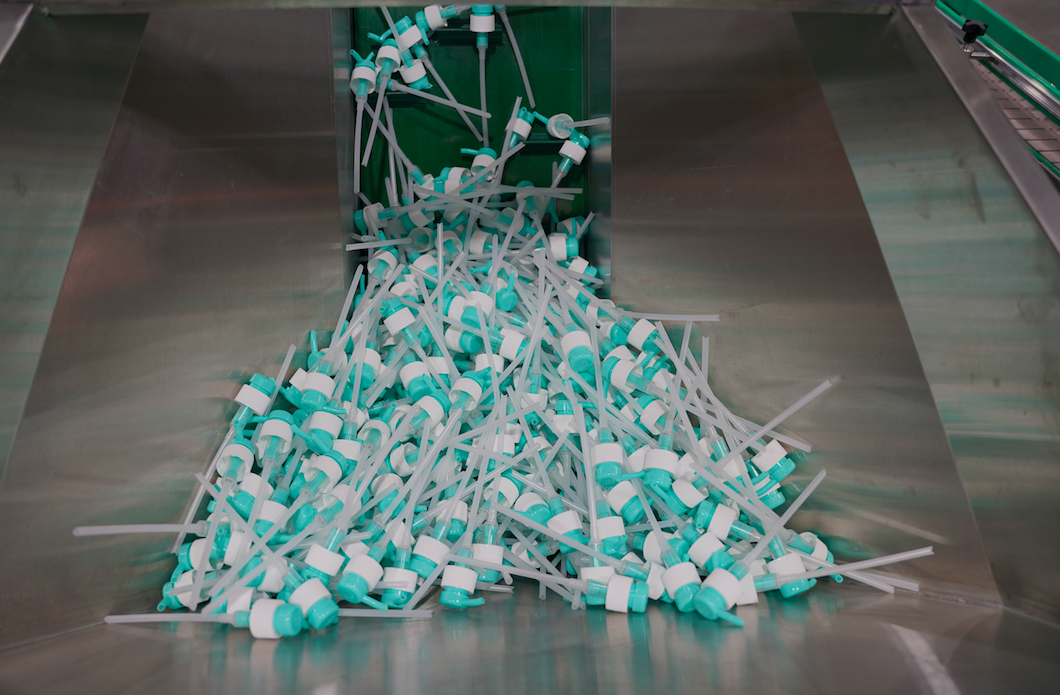
Long dip tubes can overlap during bulk handling. Feeding should be tested with normal production variation, not only carefully selected samples.
| View Pump Feeding Machine | Request a Sample Review |
Which Capping Machine Fits the Production Plan?
The machine should be selected after the placement method is clear. The common project paths below solve different production needs.
| Production condition | Practical equipment path | Why it fits |
|---|---|---|
| The pump is placed manually or by a separate system | Dedicated pump-cap tightening machine | Keeps the project focused on bottle holding, collar grip and controlled tightening. |
| The bottle and pump range is stable | Servo rotary capping review | Worth evaluating when a continuous capping process and dedicated handling parts are justified. |
| Several pumps change during normal production | Accessible configuration with confirmed change parts | Prioritizes adjustment access and realistic changeover over a fixed machine label. |
| Foam, dripping or bottle movement affects capping | Filling and capping line review | The upstream process should be corrected before choosing a faster capper. |
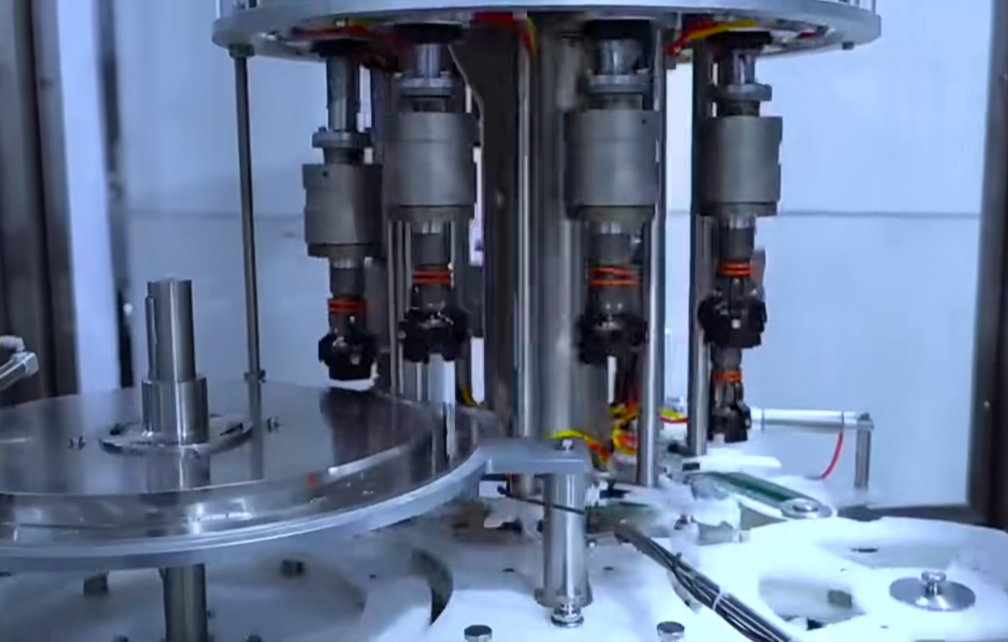
A servo rotary machine should be reviewed after pump placement, tube entry, bottle support and format changeover have been confirmed.
| View Servo Rotary Machine | Compare Configurations |
Do not compare machines from rated speed alone. Practical output depends on cap supply, tube insertion, thread engagement, bottle stability, tightening time, orientation and downstream line balance.
What a Useful Sample Test Must Show
Closing one carefully prepared bottle is not enough. A useful test should show how the proposed method handles normal bottle and pump variation through the complete sequence.
Dip-tube entry
The tube enters without folding against the neck, catching the shoulder or pushing the pump into a tilted position.
Thread engagement
The collar begins straight before full tightening. Cross-threading should be treated as a placement problem, not corrected by applying more force.
Closure contact
The capping head grips the intended part of the pump without scratching the actuator, deforming the collar or turning only the nozzle.
Bottle support
The container remains centered without excessive rotation, body deformation or movement under the capping head.
Finished pump function
The pump remains usable and the finished package meets the buyer’s functional, leakage and transport checks.
Repeatability across normal samples
The test includes normal variation in bottle shape, pump position and tube curvature rather than only the easiest samples.
When Pump Direction Changes the Machine Design
Tightening and orientation solve different problems. A pump collar may be secure while the actuator stops in different directions. That result can be acceptable for one package and unsuitable for another.
| Final requirement | What to specify |
|---|---|
| Secure tightening only | Confirm that pump direction is not part of the acceptance requirement. |
| Locked shipping position | Provide the required lock condition and confirm how the pump is supplied before capping. |
| Front-label direction | Provide a labeled bottle and the acceptable direction tolerance. |
| Tray or carton direction | Explain how the finished bottle enters downstream packaging and where the actuator must face. |
Do not add orientation control merely because a bottle uses a pump. Include it when the retail display, tray, carton or downstream process genuinely requires a controlled final direction.
Check the Filling Process Before Blaming the Capper
Some capping problems begin before the bottle reaches the closing station. A machine change will not correct product residue, uncontrolled foam, poor bottle spacing or unstable conveyor transfer.
| Observed issue | What to check first |
|---|---|
| The collar slips during tightening | Check whether lotion, shampoo or soap is reaching the bottle neck or capping contact area. |
| The tube misses the bottle opening | Review bottle centering, guide rails, conveyor spacing and filled-container movement. |
| Foam reaches the neck | Review filling stages, nozzle position and the time between filling and pump placement. |
| The finished bottle looks unclean | Check nozzle cut-off, dripping and product on the bottle exterior before labeling. |
When filling conditions are affecting closure placement, review the filling and capping connection before increasing capping speed or changing the tightening head.
What to Send Before Requesting a Configuration
A useful inquiry should identify the package produced most often and the format that creates the greatest handling difficulty. Photos support the first discussion, while drawings, videos and physical samples provide a stronger basis for final confirmation.
| Information group | Details to prepare |
|---|---|
| Product | Product type, flow or viscosity information, foam, stringing, dripping and filling temperature when relevant. |
| Bottle | Volume, height, width, base shape, neck finish, material, filled weight, drawings and samples. |
| Pump closure | Collar diameter, thread style, actuator shape, final tube length, lock status and required final direction. |
| Production target | Required output for each important format, production schedule and expected number of changeovers. |
| Automation scope | Manual pump placement, automatic feeding, standalone capping or connection with filling, labeling and packing. |
| Current problem | Tube bending, tilted pump, cross-threading, bottle movement, surface marks, inconsistent direction or neck contamination. |
Recommended next step
Send the main bottle and pump formats together with the actual product behavior. State whether operators can place the pump manually, whether automatic feeding is required and whether the actuator needs a controlled final direction.
| Send Project Details | View Pump Cap Capping Machine |
Related Reading
Compare the handling requirements of pump dispensers, trigger sprayers and standard screw caps.
See how foam, neck residue, bottle spacing and conveyor transfer affect downstream closure handling.
Review liquid behavior, bottle format, filling method and complete-line planning before equipment selection.
Pump Cap Capping Machine FAQ
Can one machine handle lotion, shampoo and hand-wash pump bottles?
One machine may support several bottle and pump formats when they fall within a confirmed changeover range. Bottle height, body stiffness, neck finish, pump collar and dip-tube length should be reviewed for each important package.
Is automatic pump feeding always necessary?
No. Manual pump placement with automatic tightening may be more practical for frequent format changes, curved tubes or pumps that do not sort reliably. Automatic feeding should be added when sample testing supports it.
Can long dip-tube pumps be handled automatically?
Automatic handling may be possible, depending on the pump shape, tube length, flexibility, incoming variation and feeding method. Production-representative samples are needed before the configuration is confirmed.
Does every pump need final direction control?
No. Some pumps only need secure tightening or a locked shipping position. Direction control is relevant when the actuator must face a label, tray, display position or carton direction.
When should a servo rotary capping machine be considered?
A servo rotary configuration may be reviewed when the main bottle and pump formats are stable and the production plan justifies a more continuous process. Final suitability depends on sample testing, changeover and line conditions.
Can a final machine configuration be confirmed from photos?
Photos and drawings support the first review, but they may not show bottle stiffness, thread engagement, tube movement, pump variation or product residue. Physical samples may be required before final confirmation.
Match the Machine to the Real Bottle and Pump
Begin with the package produced most often and the format that creates the greatest handling difficulty. The technical review can then determine whether the project needs manual placement, automatic feeding, a dedicated pump capper or a servo rotary capping system.
| View Pump Cap Capping Machine | Contact Runtech |