
For engine-oil packaging in 1–5 L containers, RUNTECH lists a lubricant filling and capping line for this product range. The important consideration is whether the actual oil, container formats and matching closures can be accommodated by the proposed equipment configuration.
A 1 L bottle and a 5 L container may share the same packaging line, but that does not automatically mean they use identical settings or handling arrangements. Their dimensions, openings and closure designs need to be reviewed together before the equipment configuration is confirmed.
Start with 1–5 L engine-oil packaging needs
The 1–5 L range covers several practical engine-oil packaging formats. Smaller containers and larger handled packs can serve different distribution and end-use requirements, even when they contain the same lubricant formulation.
This difference matters when assessing a filling and capping line. A 1 L bottle may have a relatively compact body and a different neck position, while a larger container may have a wider footprint, a higher center of gravity or an integrated handle. These differences can affect how each package is presented, positioned and supported during production.
The first decision is therefore which sizes will actually be included in the production plan. If the line needs to handle both 1 L and 5 L packs, both formats should be considered during the equipment review. The published volume range is a starting point, not automatic confirmation that every bottle design within it is interchangeable.
Match the listed lubricant application to the actual product
RUNTECH’s lubricant oil filling and capping line is listed for lubricant products in the 1–5 L range and describes quick adjustment when changing package specifications. The published description does not clearly establish whether cap placement and final tightening are fully automatic or operator-assisted, so the closing arrangement should be confirmed for the proposed configuration.
Engine-oil formulations should be reviewed under their intended filling conditions. Viscosity at the filling temperature, product flow through the nozzle and dripping after cutoff can all affect a filling trial. If several oil grades will share the line, include representative samples of the products with the most demanding filling behavior rather than assuming one grade represents the full range.
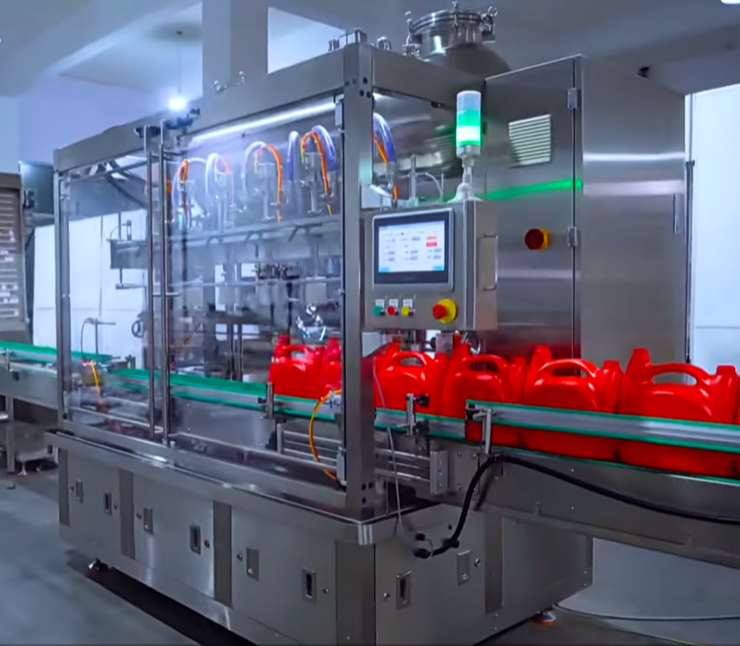
The product page identifies the intended lubricant range, but a project review still needs the actual oil and its filling conditions. Where several formulations or container sizes will share the line, list each product-and-package combination rather than treating one sample as representative of the full range.
Check the bottle and closure within this packaging range
Two engine-oil containers can have the same nominal capacity but different packaging requirements. Bottle height, footprint, shoulder profile, neck finish and opening dimensions all help determine whether the proposed equipment arrangement is appropriate.
Larger packs deserve particular attention when their design includes an integrated handle. The handle position and overall container shape may influence how the pack is oriented and presented to the filling and closing stations. A drawing review can identify potential differences, but representative physical containers provide a more reliable basis for assessing the actual package.
The closure is equally important. A screw cap must match the corresponding bottle neck and thread design. A change in cap height, opening dimensions or neck finish can affect how the closure is presented and engaged, even if the container capacity remains unchanged.
One detail worth checking
For each planned format, record the bottle reference, neck finish, matching cap and closing method. This makes it easier to identify which formats may share an arrangement and which need separate confirmation.
For lubricant manufacturers and contract packers managing several packaging formats, this is particularly relevant when introducing a new bottle design or adding another container size to an existing product range.
For a broader specification approach to multiple bottle sizes, see RUNTECH’s guide to filling and capping machines for multiple bottle sizes.
Clarify the filling-and-capping equipment scope
A lubricant filling and capping line needs to be considered as a connected packaging application. Filling the engine oil and securing the matching closure are related stages, but each depends on different parts of the package.
The filling side needs to be assessed against the lubricant sample, container opening and intended fill format. The closing side needs to be reviewed against the bottle neck and corresponding cap. A suitable filling arrangement alone does not establish that every closure combination is also compatible.
It is also worth distinguishing the main filling-and-capping equipment from the wider packaging system. The term packaging line should not automatically be interpreted as confirmation that labeling, cartoning or other downstream operations are included in every proposed supply scope.
Before confirming the equipment scope, clarify which filling and closing operations are included, whether cap placement and tightening are automatic or operator-assisted, how the selected bottle formats are accommodated and whether labeling, coding, cartoning or other downstream equipment is supplied separately.
Confirm Output and Filling Accuracy for the Actual Application
The product page lists an output range in barrels per hour and a filling-accuracy figure of ±7 g for a 5 L bottle. It does not clarify whether “barrels” refers to the 1–5 L containers or another production unit, and it does not define the operating conditions behind the figures. Confirm the intended output unit, product, container size and test conditions with RUNTECH before using them as project specifications.
Performance information from a food-oil application or another filling machine should not be reused as an engine-oil specification. The actual formulation, filling temperature, package and agreed operating conditions all matter when setting a realistic output and filling-accuracy target.
Before requesting a project review, prepare three groups of information:
- Product and filling conditions: Identify each engine-oil grade, provide viscosity information where available and state the intended filling temperature.
- Output and accuracy targets: State the required containers per hour for each format and the acceptable filling tolerance. Ask how the supplier’s published figures are measured.
- Packaging formats: Provide representative 1–5 L bottles and their matching caps, including each materially different bottle or closure design.
These details give RUNTECH a practical basis for reviewing the application and identifying which performance points need to be confirmed through a sample trial or agreed operating test.
Evaluate the line against the most demanding product-and-package combination, not simply the nominal 1–5 L range. Agree on the output unit, test conditions, filling-accuracy method and closing arrangement before treating performance as confirmed.
Questions before the next step
Do 1 L and 5 L packs use the same agreed configuration?
Not necessarily. Both sizes are within the listed application range, but bottle dimensions, openings and closures may differ. The actual samples should be reviewed before confirming whether one agreed configuration can accommodate both.
Can food-oil performance figures be reused for engine oil?
No. Figures from another liquid application should not be treated as confirmed engine-oil performance. The lubricant formulation, container and operating conditions need to be assessed for the specific project.
Does the filling and capping line include labeling and carton packing?
Not necessarily. Check the supply scope station by station. Confirm whether bottle feeding, cap placement and tightening, labeling, coding and carton packing are included or require separate equipment.
RUNTECH | Lubricant Packaging
Discuss Your 1–5 L Engine-Oil Packaging Application
Share the engine-oil grade, viscosity information, filling temperature, target output, bottle specifications and matching cap samples. These details will help RUNTECH review the application and discuss a suitable filling and capping configuration.