A 500 ml bottle and a 5,000 ml container may both fall within the same filling range, but that does not mean they will run at the same speed or require identical handling. RUNTECH’s liquid food filling and capping line is listed with eight customizable filling heads and an output range of 1,000–7,200 bottles per hour, calculated using 1,000 ml water. The useful question for food producers is how those specifications relate to their products, packaging formats and production targets.
|
Format range 500–5,000 ml Published filling range |
Filling heads 8 heads Customizable arrangement |
Published output 1,000–7,200 Bottles/hour; 1,000 ml water |
| Formats | 8 Heads | Output | Product | Scope | FAQ |
What the 500–5,000 ml range means for bottle formats
RUNTECH lists a filling range of 500–5,000 ml, covering several commonly used food packaging volumes. For producers offering multiple pack sizes, this is a useful starting point—but filling volume alone does not tell you whether every bottle can move smoothly through the proposed equipment.
Volume alone does not establish compatibility with every bottle design. A compact 500 ml bottle and a larger 5,000 ml container can have substantially different shapes, openings and closure requirements, even though both fall within the same stated range.
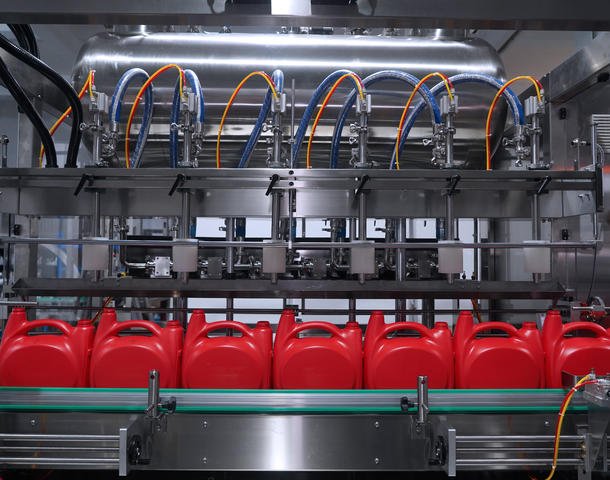
RUNTECH filling equipment with red containers positioned beneath the filling heads.
Bring the actual bottles into the discussion, especially where the sizes have different necks, footprints or caps. For a closer look at the dimensions and changeovers involved, see RUNTECH’s guide to filling and capping multiple bottle sizes.
What eight customizable filling heads mean for output
The listed liquid food filling and capping line has eight customizable filling heads. That tells you how many filling positions are specified, but it does not, by itself, tell you how many finished bottles the complete line can produce each hour.
Filling speed depends on the volume delivered in each cycle and how the product flows through the system. Bottle transfer and downstream capping can affect the pace of the complete line as well. The product page does not detail every adjustment covered by “customizable,” so the filling-head arrangement and its settings should be discussed using the intended product and bottle samples.

The practical distinction is between the filling-head specification and the output that can be maintained with the selected food product, bottle and closure combination.
What the 1,000–7,200 bottles/hour figure tells you
RUNTECH lists a production range of 1,000–7,200 bottles per hour for the filling equipment, calculated using 1,000 ml water. The product page does not establish a separately verified capacity for the complete filling-and-capping line. If the production target is finished bottles per hour, filling and capping performance need to be assessed together.
The published figure does not give separate speeds for 500 ml, 1 L and 5 L formats. At a given filling flow rate, larger volumes take longer to dispense; bottle transfer and capping speed can also limit the rate of completed bottles.
If several sizes are planned, compare the expected finished-bottle output for each important product-and-container combination. A trial using representative samples is more informative than applying the water-based figure to every format.
How the food product affects filling performance
Water is a useful reference liquid, but food formulations do not all behave like water. Differences in viscosity and consistency can change the filling conditions, so a published water-based output should not automatically be applied to a thicker product.
The equipment page describes applications involving aqueous solutions and cream-based formulations, including high-viscosity materials. It does not provide separate production rates for individual liquid foods. Suitability for a particular formulation and the corresponding output remain matters for application-specific confirmation.
A trial with the actual food product should look beyond the hourly rate. Check whether filling stays consistent over repeated cycles, whether the product cuts off cleanly at the nozzle and whether the proposed setup can maintain the required pace. Those observations offer a stronger basis for evaluating the line than the water-based reference alone.
Check how filling and capping work together
A suitable filling range is only part of the decision. The proposed line also needs to handle the selected bottles and closures at the required production pace. RUNTECH’s product description focuses mainly on the filling equipment, so the project discussion should establish which capping and labeling operations are included and how the connected stages are expected to work together.
Bottle-neck dimensions, closure types and the way containers transfer from filling to capping matter alongside the fill volume. These are practical details to settle before comparing the expected output of the complete line.
For the application discussion, the most useful information is:
- The actual liquid food product, ideally with a representative material sample.
- The filling volumes that will be used within the 500–5,000 ml range.
- Representative bottles and the corresponding closure samples.
- The required output for the intended product and packaging formats.
Together, these details give RUNTECH a practical basis for matching the proposed equipment to the production brief and discussing a realistic finished-bottle output.
Questions before the next step
Does the quoted rate apply to 5,000 ml containers?
Not as a confirmed rate. The published 1,000–7,200 bottles/hour is based on 1,000 ml water. Output for 5,000 ml containers requires separate confirmation.
What should be checked when filling a thicker food product?
Use a representative sample to check fill consistency, nozzle cut-off and sustained operating pace. The published rate is based on 1,000 ml water and cannot establish these results for thicker foods.
What does customizable mean for the eight heads?
The page confirms eight customizable heads but does not list every possible adjustment. Confirm the customization scope against the intended product and containers.
Application Review
Discuss the line around your actual packaging formats
Share the food product, planned filling volumes, bottle-and-cap samples and target finished-bottle output. RUNTECH can use that information to discuss the proposed filling arrangement and clarify the capping or labeling scope for your application.
| Discuss Your Application | View Line Details |