
A filling line should match the way production actually runs, not an isolated speed target. Batch length, bottle movement, changeover frequency, operator access, and downstream limits all shape the result. For that reason, choosing the right automatic filling machine starts with the production pattern and a clear comparison between linear and rotary architecture.
A linear system often supports flexible schedules and frequent product changes. By comparison, a rotary system can suit sustained output with a stable container and process. Neither layout is automatically better; the right architecture removes the most expensive constraint from the whole line.
Decision focus: This comparison concerns production-line architecture. Metering technologies such as piston, gear pump, flow meter, or weighing systems require a separate product-based review.
Jump to: Differences | Capacity | SKU & Changeovers | Floor Space | Maintenance | Matrix | Input Data | Decision | FAQ
Linear and Rotary Solve Different Production Problems
Many linear layouts move containers along a straight conveyor and index them beneath filling nozzles, while following or tracking configurations can fill bottles as they continue moving. The open arrangement makes stations easier to see, reach, and adjust. As a result, the architecture often fits plants that run several bottle formats, shorter campaigns, or regular cleaning cycles.
A linear filling machine also gives layout planners clear control over upstream and downstream spacing. Extra conveyor accumulation can be added where operations need a buffer. However, a long straight path may consume valuable wall length or restrict traffic around the line.
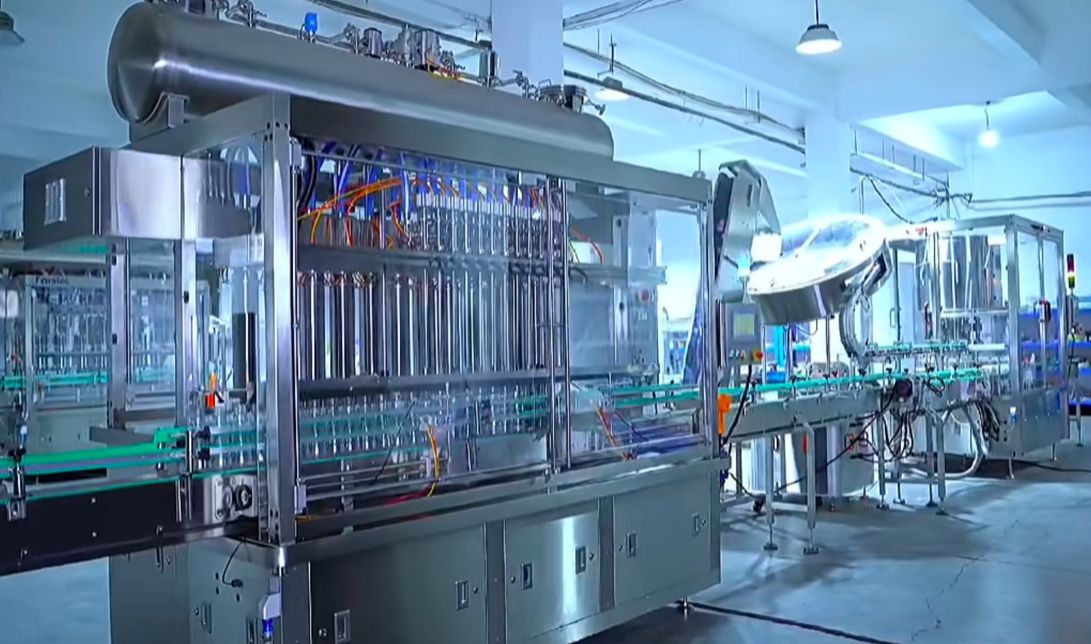
The straight conveyor shows how a linear filling station connects with downstream packaging equipment.
By contrast, a rotary layout transfers containers through stations arranged around a central structure. Multiple process positions can operate within a compact circular path. This approach can support continuous, repeatable production when bottle geometry, fill behavior, and scheduling remain stable.
A rotary filling machine becomes relevant when sustained throughput matters more than frequent reconfiguration. Still, the central machine footprint does not tell the full story. Infeed, discharge, guarding, utilities, access doors, and maintenance clearance remain part of the installed space.
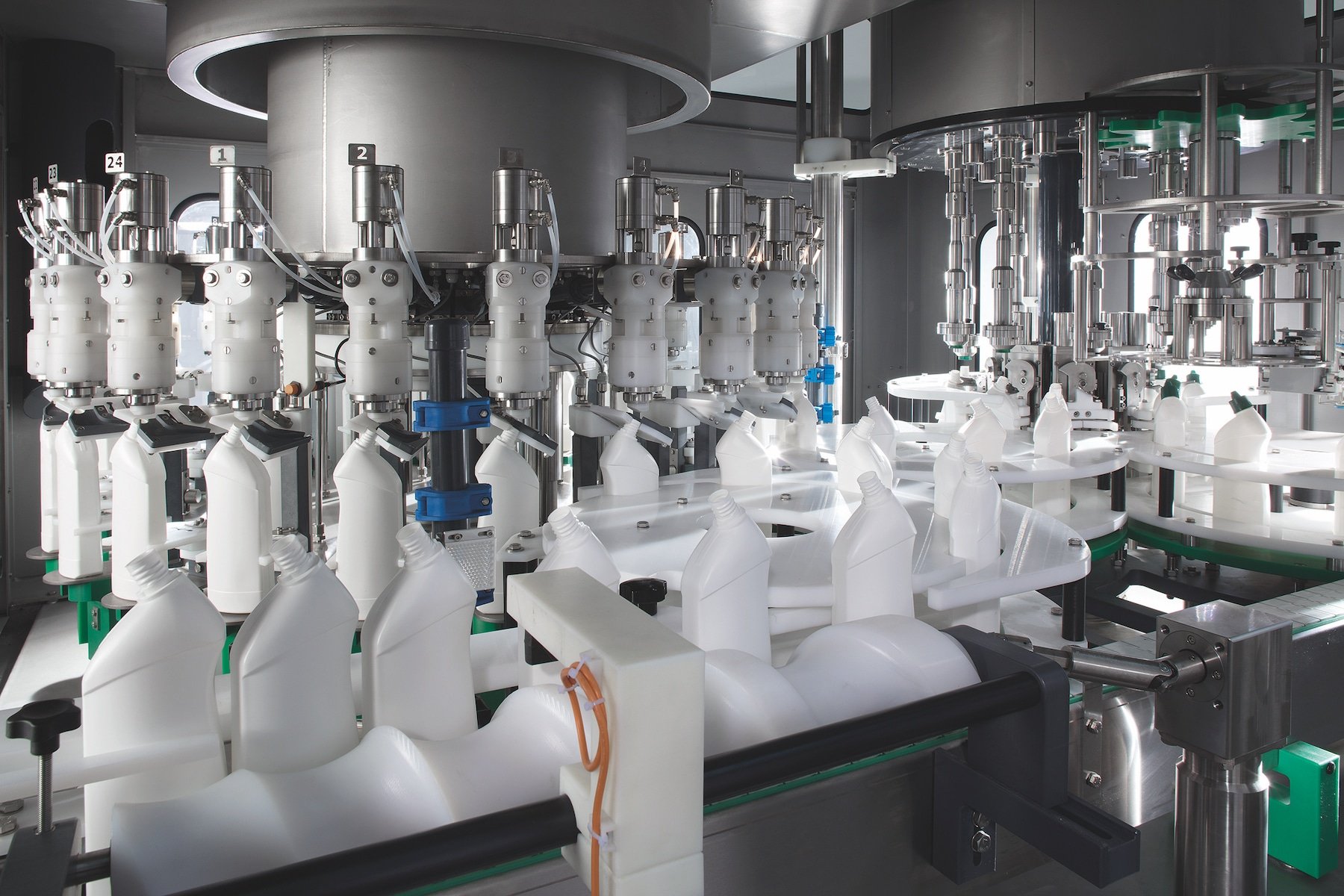
Circular bottle handling concentrates stations for sustained, repeatable production campaigns.
Capacity Is More Than Nameplate Speed
Nameplate speed describes a machine under defined conditions. Actual line output reflects a wider system. Bottle supply, filling time, foam control, nozzle movement, capping, labeling, inspection, and packing can each become the governing step.
For example, a filler may wait because containers arrive unevenly. It may also slow because a foaming liquid needs a controlled fill profile. Meanwhile, a downstream capper can create repeated stops if caps do not feed consistently.
For buyers, the more useful capacity figure is stable saleable output per shift. Planned cleaning, changeovers, material replenishment, minor stops, startup waste, and operator breaks all reduce that figure. A high cycle rate brings little value when the line repeatedly loses synchronization.
Product recovery also matters after every stop. Bottles may need removal, inspection, refilling, or rejection before flow resumes. Recording these small losses during current production can reveal whether speed, reliability, or faster recovery deserves the highest priority.
Use a production window instead of one headline number
One headline number hides the way demand changes across a production schedule. A more realistic capacity window includes the normal target, expected peak, minimum acceptable output, and operating hours available for each SKU. That gives engineering teams a consistent basis for comparing both architectures.
The filler is not always the process that sets the pace. Thick or foaming products may extend filling time, while complex closures may limit capping. If one downstream operation remains slower, increasing filler capacity alone will not raise finished output.
Buffer strategy matters as well. Short accumulation zones can absorb brief interruptions without stopping every machine. Yet excessive buffering adds floor space, work in process, and more containers exposed between operations.
Changeover Frequency and SKU Mix
SKU count alone does not describe changeover demand. Two SKUs may use the same bottle and closure but different liquids. Conversely, one product family may involve several bottle heights, neck positions, labels, pumps, and trigger closures.
Changeover losses come from two different sources. Product changes can require draining, cleaning, flushing, or replacing contact parts. Format changes may involve guides, nozzle positions, conveyor settings, star wheels, screws, or transfer parts. Separating these tasks makes the comparison more accurate than using SKU count alone.
Linear equipment often offers direct access to guides and filling positions. That access can simplify observation during setup and reduce the number of concealed adjustment points. Even so, actual changeover time depends on the supplied tooling, adjustment design, cleaning method, and documented procedure.
Rotary systems may deliver strong performance during long campaigns, yet format parts deserve close review. A new bottle can affect infeed timing, star-wheel pockets, transfer clearances, filling position, and discharge control. Frequent format changes can offset the output advantage if each setup consumes substantial production time.
How the production schedule changes the decision
- Long campaigns with few formats: prioritize sustained flow, dependable feeding, and balanced downstream speed.
- Short campaigns with many formats: prioritize access, repeatable settings, cleaning effort, and tool control.
- Seasonal peaks: compare peak demand with the production hours available during that period.
- Mixed production: identify the dominant volume SKU and the formats that create the hardest changeovers.
Real samples keep this comparison grounded in production rather than catalog assumptions. Each bottle, cap, pump, or trigger needs checking under realistic line conditions, while the liquid should represent expected viscosity, temperature, and foaming behavior.
Floor Space, Conveyor Flow and Operator Access
Floor-space comparisons often fail because they use only the machine outline. A workable layout also needs conveyor approaches, electrical cabinets, tanks or product supply, guarding, door swing, cleaning access, and safe walking routes. Utility drops and drainage may further limit orientation.
A linear line generally needs more usable length along the conveyor direction. However, its narrow form can fit beside a wall or within an existing straight production flow. Operators can often view several stations from one side, depending on guarding and access design.
A rotary machine may concentrate processing within a shorter central footprint. Nevertheless, space around the circumference must stay available for access and service. The infeed and discharge paths can also create bends that affect adjacent equipment.
The fair comparison is the complete installed envelope, not the catalog outline. A scaled floor plan can show the full line together with operator positions, pallet movement, material staging, reject collection, cleaning carts, and emergency routes.
Where conveyor behavior changes the result
Container stability changes with bottle shape, base size, center of gravity, and conveyor speed. Tall or lightweight bottles may need careful guide control. Irregular containers can also create gaps or orientation problems before filling.
Line balance also depends on clean transfers. Repeated back pressure between unscrambling, filling, and capping can erase the advantage of a faster machine. The layout therefore needs enough safe accumulation space without allowing containers to build up at unstable transfer points.
Maintenance and Production Interruption Considerations
Maintenance becomes a purchasing issue when access, fault isolation, cleaning, or recovery takes longer than production can tolerate. A fast machine that is difficult to service may still create expensive interruptions. Spare-part strategy and local technical capability also shape that risk.
Linear systems can make mechanisms and product paths easier to inspect because stations follow a straight arrangement. In some configurations, one area can be reached without entering the entire machine. Still, the final service plan depends on guarding, controls, and component placement.
Rotary equipment brings several coordinated stations into one structure. That integration can support smooth continuous flow, but a central fault may affect the full process. In this case, fault detection, access panels, lubrication points, and change-part handling have a direct effect on recovery time.
Cleaning adds another operating trade-off. Product-contact parts, hoses, tanks, manifolds, and nozzles need to suit the sanitation method. Incompatible products may justify dedicated contact sets or a validated cleaning sequence, especially when product changes are frequent.
Estimate interruption cost, not only maintenance frequency
Two lines can have similar maintenance hours but different business effects. A brief stop during a long campaign may be manageable. The same stop during a narrow seasonal window can threaten the entire schedule.
The business comparison becomes clearer when probable stop causes are matched with restart steps and the people qualified to make each adjustment. Clear ownership reduces delays when production conditions change.
Automatic Filling Machine Selection Matrix by Batch Size and Product Mix
The matrix below offers a practical starting point. It does not replace bottle trials or a confirmed line layout. Instead, it shows which questions should receive more weight during early screening.
| Production pattern | Likely starting point | Main confirmation |
|---|---|---|
| Short batches and frequent bottle changes | Review linear architecture first | Change parts, access, cleaning time, and repeatable settings |
| Long campaigns with stable containers | Review rotary architecture first | Sustained line output, feeding stability, and downstream balance |
| Many SKUs but one dominant high-volume format | Compare campaign value against changeover loss | Annual schedule by SKU, not a simple SKU count |
| Restricted room with existing equipment | Create both scaled layouts | Installed envelope, access zones, utilities, and conveyor transfers |
| Unstable bottles, closures, or liquid behavior | Delay architecture choice until trials | Representative samples, fill behavior, handling, and rejection points |
The strongest choice usually follows the dominant production loss. If changeovers consume the schedule, flexibility deserves more weight. If stable high-volume campaigns cannot meet demand, continuous output becomes the main concern.
Mixed operations may need a different answer. Separating a high-volume line from a flexible line can sometimes reduce compromise. That option should be evaluated only after annual volume, staffing, room, and investment priorities are clear.
What Suppliers Need Before Confirming the Layout
A target rate alone does not give a supplier enough information to compare linear and rotary layouts. The operating case becomes clearer when production demand, package formats, product behavior, room constraints, and connected equipment are reviewed together:
- Normal and peak output targets, stated with available shifts and operating hours.
- Annual or monthly volume by SKU, plus typical campaign length.
- Number of product, bottle, and closure changes during a shift or week.
- Bottle drawings, filled samples, dimensions, materials, and stability concerns.
- Closure types, including caps, pumps, triggers, plugs, or special components.
- Liquid samples and notes on viscosity, foam, temperature, particles, or stringing.
- Available room dimensions, ceiling height, columns, doors, drains, and utility points.
- Upstream and downstream equipment, including interface heights and current speeds.
- Cleaning method, product compatibility rules, and expected sanitation frequency.
- Operator count, material delivery route, finished-pack removal, and maintenance access.
A scaled drawing makes fixed constraints such as columns, walls, doors, drains, and conveyor directions visible early. Photos add context, while bottle and closure samples reveal handling and changeover issues that drawings cannot show.
Both concepts are most useful when they are presented under the same assumptions. The installed envelope, expected operating pattern, changeover scope, access zones, and interface responsibilities then become directly comparable, rather than allowing a compact drawing or headline rate to control the decision.
Turn Production Data Into a Layout Decision
Linear and rotary filling systems create value in different production environments. Linear architecture often favors accessible adjustment and varied schedules. Rotary architecture often favors long, stable campaigns and concentrated processing.
Three inputs usually move the project from a general comparison to a workable layout:
- Measure the real space: include access, utilities, cleaning routes, and adjacent equipment.
- Map the SKU schedule: record batch length, bottle changes, liquid changes, and weekly changeover frequency.
- Test representative samples: use the hardest bottle, closure, and liquid combinations rather than the easiest SKU.
With the target capacity range, SKU count, changeover pattern, bottle formats, factory dimensions, connected equipment, and shift plan, Runtech can compare both routes around the actual production case. Submit those details through the project contact page so the next discussion can focus on layout fit, interface risks, and sample testing.
Frequently Asked Questions
When is a rotary filling system worth considering?
A rotary concept deserves review when long campaigns and steady container formats make sustained output the main priority. The assessment should still include downstream capacity, feeding stability, service access, and realistic production hours. Representative bottle and liquid trials remain important before configuration.
Is a linear system always easier to change over?
Not always. A straight, open arrangement can improve access and visibility, but actual changeover effort depends on tooling, guides, nozzle adjustment, recipes, cleaning, and operator procedure. The correct comparison uses a defined SKU change and measures every required task.
How should floor space be compared?
Compare complete installed layouts at the same scale. Include conveyor approaches, guarding, electrical cabinets, product supply, maintenance zones, operator positions, and material routes. Machine outline dimensions alone can hide the space needed for safe daily operation.
Which production data should be prepared before selection?
Prepare normal and peak output targets, volume by SKU, campaign length, changeover frequency, bottle and closure details, liquid behavior, room dimensions, shift plans, and connected equipment. Samples and a marked floor drawing will make the architecture review more reliable.