
Choosing an automatic liquid filling machine starts with the product and production pattern, not a preferred pump name. Piston, gear pump, flow meter, and weighing systems create different paths for dosing, cleaning, changeover, and process control. In practice, the right route depends on how the liquid flows, how the fill target changes, and how often the line switches products. A useful decision must also consider air entrainment, foaming, temperature, container stability, and the acceptable amount of product left inside the circuit.
Jump to: Differences | Input Data | Matrix | Trade-offs | Poor Fit | Confirmation | RFQ | FAQ
What Actually Changes Between the Four Filling Routes?
That approach avoids a common selection error: comparing filling technologies through one accuracy claim. Each route can perform well inside a suitable operating window. However, the same route may become difficult when viscosity shifts, containers vary, or cleaning happens several times per shift. The goal is not to name one universal winner, but to define the most stable process for the planned product family.
At the center of the comparison is the dosing reference. A piston system displaces a defined chamber volume during each cycle. A gear pump controls transferred liquid through pump rotation and the programmed dose. By contrast, a flow meter measures product passing through a line, while a weighing system stops filling when the measured mass reaches its target.
That difference changes more than the metering device. It affects the product path, valve sequence, nozzle behavior, control response, and residue after production. For example, a thick cream may fill predictably through a correctly sized piston circuit. The same product may place different demands on a pump route because shear, suction, and feed pressure also matter.
Meanwhile, the supply condition influences every route. A stable head pressure supports repeatable feeding, while an inconsistent product level can change suction behavior. Recirculation may improve consistency for some formulations, yet it can add heat or aeration to others. As a result, the filling unit cannot be separated from the hopper, transfer pump, pipework, and upstream preparation process.
Piston dosing controls a displaced volume
In a piston circuit, the cylinder draws product and then pushes it toward the nozzle. This positive-displacement principle can suit liquids that need a decisive transfer action. In particular, it often deserves evaluation for lotions, gels, creams, and other products with meaningful viscosity.
However, the complete product path still determines performance. Valve ports, seals, cylinder dimensions, nozzle opening, and feed conditions must match the formulation. A product containing particles, fibers, or abrasive ingredients needs separate confirmation because internal clearances and valve geometry become critical.
Gear pump dosing links delivery to controlled rotation
With a gear pump route, rotating elements move product through the circuit. Servo control can coordinate pump movement with the target dose and nozzle sequence. This control supports flexible recipes when the liquid remains compatible with the pump design.
Even so, pump compatibility matters more than a broad viscosity label. Dry-running risk, seal compatibility, shear sensitivity, suspended solids, and crystallizing ingredients can change the result. A stable bench sample may also behave differently after repeated circulation or a warm production shift.
Flow meter dosing measures product in motion
A flow meter route uses measured flow as the control reference. The exact behavior depends on the meter principle, product properties, and installation arrangement. Consequently, the meter type must be confirmed against conductivity, density behavior, entrained gas, cleanliness, and the planned process temperature.
When product flow remains stable, the route can reduce dependence on a fixed dosing chamber. Recipe changes may then rely more on control settings than mechanical volume changes. Still, meter verification remains part of line validation because the measured signal must represent the actual filled quantity.
Weighing dosing measures mass at the container
A weighing route places the container on a load-cell-based station and monitors added mass. This method changes the control question from transferred volume to measured weight. For that reason, it can become attractive when mass is the commercial or process target.
At the same time, the weighing station reacts to its environment. Conveyor vibration, container movement, hose pull, product impact, and unstable tare values can disturb the signal. Mechanical isolation and a controlled settling sequence are therefore as important as the weighing instrument itself.
Start With the Liquid, Fill Range and Production Pattern
A technology comparison becomes useful only after the application window is defined. Thin and viscous are helpful starting words, but they do not describe enough. Instead, the review should include flow behavior at rest, flow under pumping, recovery after shear, foaming tendency, and temperature sensitivity.
For instance, two lotions can share a similar measured viscosity and still fill differently. One may level quickly inside the bottle, while another forms a tail at the nozzle. Likewise, one formula may tolerate recirculation, whereas another traps air and expands after repeated handling.
Describe flow behavior under real production conditions
Viscosity should be recorded at a meaningful temperature and after realistic product handling. A single room-temperature value can hide changes caused by warm mixing, overnight storage, or cold start-up. Representative samples should cover the least favorable expected condition, not only the easiest batch.
Next, note whether the product is Newtonian or changes under shear. Water-like liquids usually keep a consistent relationship between pressure and flow. By contrast, many gels, shampoos, and creams become easier to move during pumping, then thicken again after filling.
Foaming adds another decision layer. A fast nozzle opening may create bubbles even when the liquid itself appears thin. Consequently, fill profile, nozzle position, and return flow require evaluation alongside the metering route.
Stringing and dripping also deserve separate attention. A route may achieve the correct dose but leave product on the bottle neck. In that case, nozzle cut-off behavior and decompression control may matter more than a small metering difference.
Define the fill range as a family, not one nominal size
The smallest and largest target fills should appear in the same application brief. More importantly, the expected production frequency for each size should be stated. A large theoretical range has limited value if its extremes require slow cycles or frequent mechanical changes.
For a piston route, chamber sizing affects how effectively one stroke serves different targets. Very small doses from a large cylinder may reduce useful adjustment resolution. Conversely, a small cylinder may require multiple actions for a much larger fill, which changes cycle behavior.
Gear pump and flow meter routes can offer recipe flexibility without changing a dosing cylinder. However, nozzle size, tubing diameter, and pump selection still create an operating window. As a result, an electronic recipe does not remove every physical change between distant fill volumes.
Weighing also needs a sensible mass range and stable container support. A station configured around heavier packs may not suit a very small target without separate evaluation. Thus, one broad line specification should not assume equal performance across every package size.
Map production patterns before comparing headline speed
A long campaign with one formula rewards stability and low interruption. In contrast, short campaigns reward fast cleaning, low retained product, and simple recipe recovery. The production calendar can therefore change the preferred route even when the liquid remains identical.
SKU count alone does not explain changeover demand. Ten fragrances using one base formula may create a different cleaning burden than three incompatible chemistries. Meanwhile, frequent bottle changes can affect nozzle spacing, guide rails, container handling, and filling height.
Batch size also changes the value of product recovery. Residue inside hoses, cylinders, manifolds, and return lines may be minor during long runs. However, the same retained quantity can materially affect a small premium batch or a frequent color change.
Finally, the filling route must fit the wider line rhythm. Product delivery, bottle infeed, filling, cap placement, capping, and discharge need balanced behavior. A metering system that fills rapidly but requires long settling time may not improve total line output.
Where these filling routes fit the strongest packaging markets
Runtech’s strongest market fit is daily chemical and household cleaning production. Typical products include laundry detergent, liquid soap, hand wash, dishwashing liquid, disinfectant, fabric-care liquid, and related cleaners. These lines often combine foaming formulas, several viscosities, and bottles using pump, trigger, flip-top, or screw closures.
Personal care and cosmetic production forms another core application group. Shampoo, conditioner, shower gel, lotion, cream, gel, toner, and similar products place different demands on suction, shear, nozzle cut-off, and cleaning. Piston dosing often enters the early review for thicker formulas, while compatible gear pump or flow meter routes can support recipe-driven production after sample testing.
Contract packing and private-label plants also benefit from a four-route comparison. Short campaigns and frequent SKU changes increase the value of low residue, repeatable recipes, accessible wet paths, and fast release checks. In this market, the easiest machine to clean and recover may create more value than the fastest isolated filling cycle.
Food sauces, edible oils, lubricants, and industrial chemical liquids can extend the application range. However, these projects require separate confirmation of product-contact materials, corrosion risk, hygiene practice, solids, temperature, and cleaning media. Market name alone should never replace a real-product trial or a complete package review.
Piston vs Gear Pump vs Flow Meter vs Weighing: Selection Matrix
The matrix below provides a route-screening method, not a final machine specification. Each recommendation remains conditional on sample behavior, material compatibility, cleaning practice, and package format. Even so, the comparison helps remove unsuitable paths before detailed engineering begins.
| Route | Strong screening conditions | Questions that still need testing |
|---|---|---|
| Piston | Defined volume dosing; products needing positive displacement; medium-to-high viscosity candidates; stable recipes with suitable valve and nozzle geometry. | Cylinder range; seal and valve compatibility; particle passage; air pockets; cleaning access; residue; nozzle cut-off; effect of temperature. |
| Gear pump | Recipe-driven dosing; products compatible with rotary pumping; applications needing controlled pump movement and flexible electronic settings. | Shear response; dry-running risk; solids; crystallization; seal materials; suction stability; cleaning method; effect of prolonged circulation. |
| Flow meter | Stable flowing products; applications benefiting from measured-throughput control; broad recipe needs within one validated fluid path. | Meter principle; entrained air; foaming; minimum stable flow; calibration method; product conductivity or density effects; drainability. |
| Weighing | Mass-based targets; larger packs or batch-style filling candidates; products whose density may vary while mass remains the control basis. | Tare variation; vibration; settling time; hose forces; product impact; container support; coarse-and-fine fill strategy; spill control. |
When a piston route deserves priority
A piston filling machine deserves early evaluation when product movement needs firm positive displacement. The route can be practical for viscous daily chemical products when valves, seals, and nozzles match the formulation. Its dosing principle is also easy to relate to a defined swept volume.
Yet piston selection should never stop at the word “thick.” A low-viscosity liquid may also run on a suitable piston arrangement. Conversely, a sticky cream can remain troublesome if it forms air pockets, bridges at the inlet, or strings after nozzle closure.
Fill range requires particular care. One cylinder size may not serve every target equally well. The project review should identify which fills dominate production and which remain occasional.
Cleaning must consider the complete wet path. Cylinder surfaces, seals, directional valves, manifolds, and nozzles can retain different amounts. For frequent formula changes, the preferred disassembly or flushing method should be agreed before equipment confirmation.
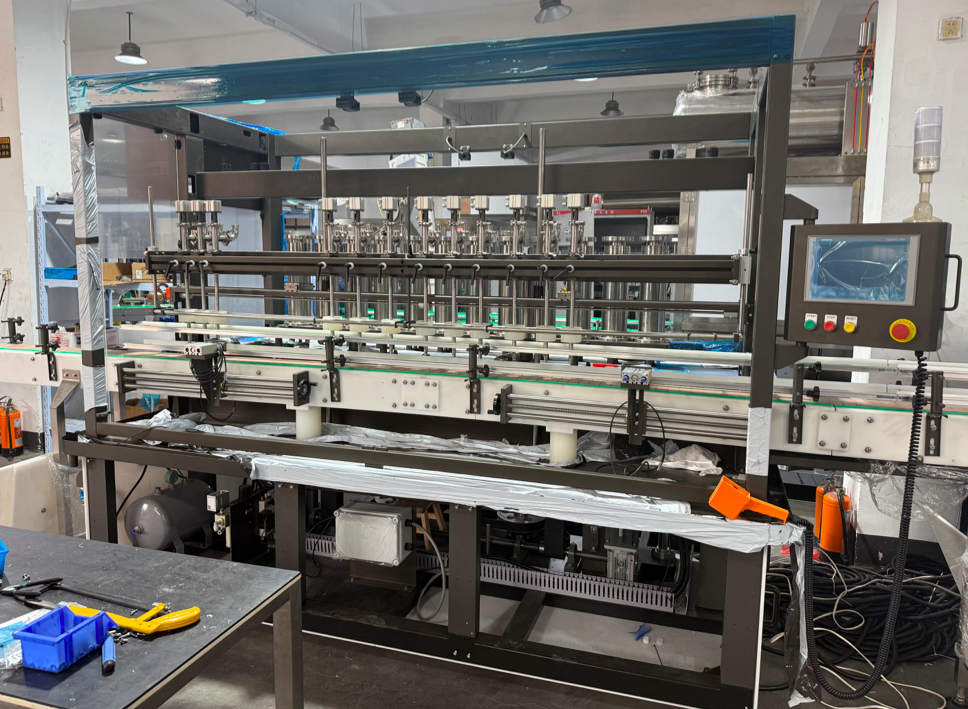
Runtech multi-head piston equipment can be reviewed for viscous daily chemical, personal care, food, and compatible industrial products.
When a gear pump route provides useful flexibility
A gear pump filling machine can suit applications that benefit from controlled rotary dosing. Recipe settings can adjust pump movement while the fluid path remains installed. This arrangement may reduce mechanical dosing changes across compatible products and fill targets.
However, electronic flexibility does not guarantee product compatibility. A shear-sensitive emulsion may change texture during pumping. Likewise, a product with suspended solids may challenge pump clearances or create uneven wear.
Suction conditions also need review. A gear pump cannot correct an unstable feed source by software alone. Instead, hopper level, pipe diameter, inlet restriction, and product temperature must support consistent pump filling.
During a sample trial, product should be checked before and after repeated circulation. Appearance, temperature, aeration, texture, and fill behavior can reveal hidden stress. This comparison is especially valuable when the planned line uses a return loop.
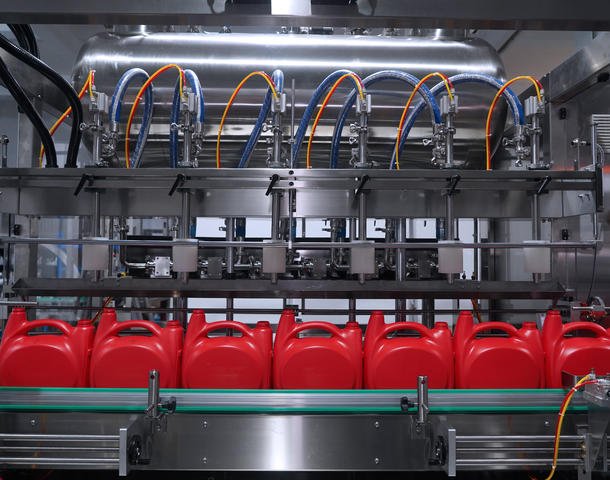
This multi-head gear pump configuration is relevant when rotary delivery, recipe control, and large-container handling match the tested liquid.
View Gear Pump Filling Machines
When measured flow is the better control reference
A flow meter filling machine can be attractive when liquid passes through a stable, measurable stream. The method supports recipe-based targets without relying on one fixed piston chamber. The control system can then use the meter signal to close the fill at the programmed quantity.
Still, “flow meter” does not describe one universal sensor. Different meter principles respond differently to product properties and installation conditions. Accordingly, the selected meter must match the formulation rather than merely the nominal flow rate.
Entrained gas is a major screening point. Bubbles can change the relationship between measured flow and actual liquid delivered. For that reason, hopper agitation, return flow, suction leakage, and foaming should be reviewed during testing.
Calibration also remains necessary. A digital value on the interface does not replace gravimetric or volumetric checks with the real product. Instead, validation should compare programmed targets with collected fills across start-up, steady running, and restart conditions.
View Flow Meter Filling Machines
When mass-based filling changes the decision
A weighing filling machine becomes relevant when mass is the desired control basis. The route can reduce direct sensitivity to product density changes because the station measures added weight. Even then, the process needs stable tare handling and a mechanically quiet measuring period.
Large or less rigid containers may need careful support. Container deformation, off-center placement, or contact with nearby guides can influence the load cell. Container drawings and physical samples should accompany the product test.
Coarse and fine filling behavior also affects the cycle. A high initial flow can approach the target quickly, while a controlled final stage reduces overshoot. The best transition point must come from product trials rather than a generic setting.
Weighing does not automatically solve foam or dripping. Product can still expand, settle, or contaminate the container neck. As with other routes, nozzle design and fill profile remain part of the complete solution.
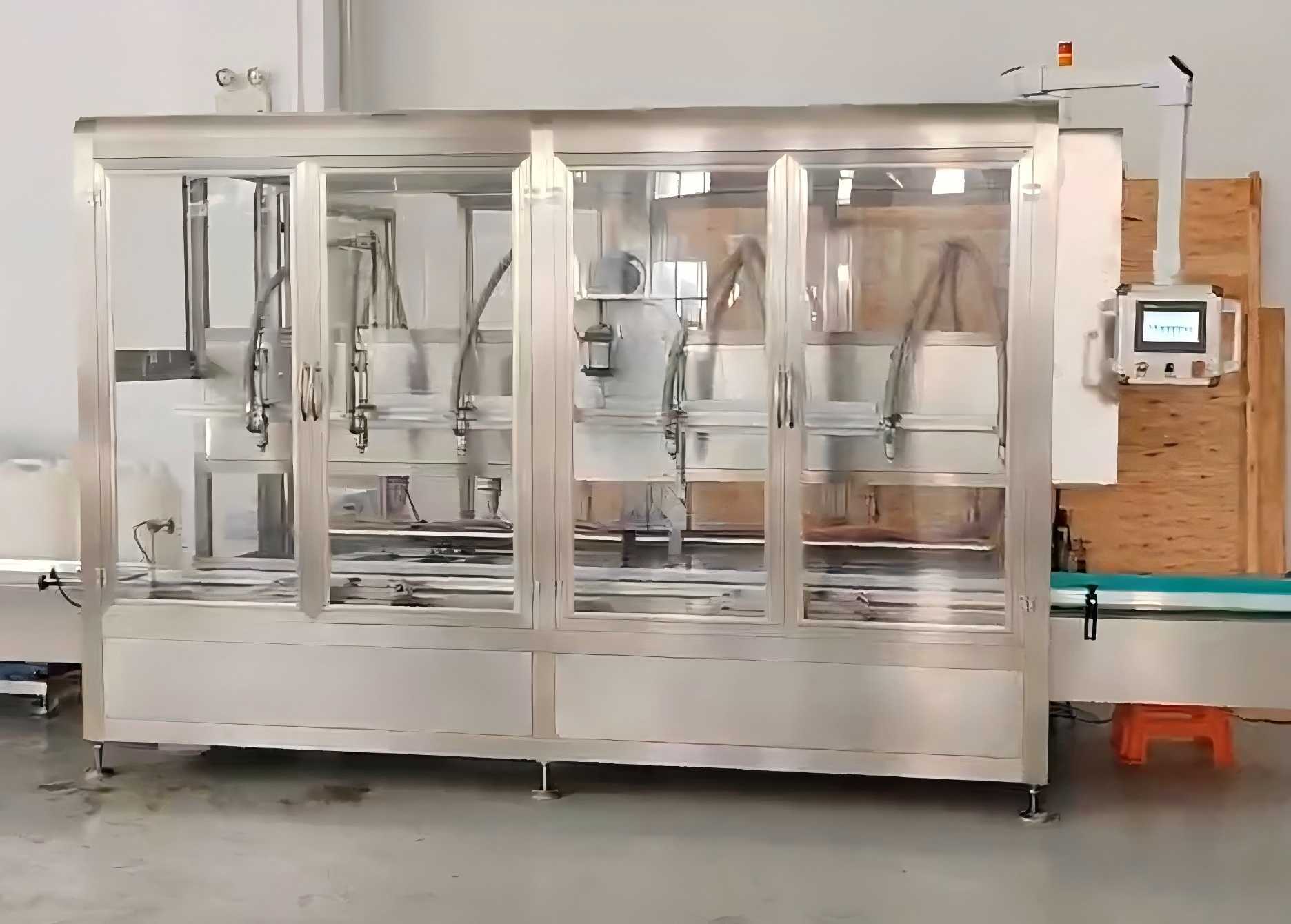
A servo weighing configuration deserves review for mass-based targets, larger packs, and products requiring controlled coarse-and-fine filling.
View Servo Weighing Filling Machines
Accuracy, Product Loss, Cleaning and Changeover Trade-offs
Accuracy should be treated as a process result, not a component label. Metering principle matters, yet supply stability, valve timing, nozzle closure, product temperature, and container handling also contribute. Consequently, a useful acceptance plan tests the assembled system with representative samples.
One quoted accuracy figure would hide these conditions and may create a false comparison. Instead, the confirmation process should define the target quantity, allowed variation, test duration, and sampling method. The same plan should state whether evaluation uses volume, net weight, or another agreed reference.
Separate repeatability from target correction
Repeatability describes how closely repeated fills group together. Target correction describes how the average fill moves toward the setpoint. Although related, these are not the same control problem.
For example, a stable but offset process may need calibration or recipe correction. An unstable process may instead require better feeding, deaeration, valve timing, or container control. Therefore, changing the setpoint cannot repair random variation caused elsewhere.
Start-up and restart behavior deserve separate samples. Product inside a stationary line may cool, separate, drain, or trap pressure. As a result, the first fills after a pause can differ from fills during steady production.
Measure product loss across the whole changeover
Product loss includes more than visible drips. Residue may remain inside supply hoses, pump cavities, cylinders, manifolds, filters, nozzles, and return lines. Accordingly, retained volume should be reviewed against batch size and product value.
A long production campaign may tolerate a more complex path because residue becomes a small share. By contrast, short batches can make the same path uneconomic. In those cases, drainability and product recovery can outweigh a minor cycle advantage.
Flush material also belongs in the loss calculation. Water, cleaning solution, or the next product can create mixed transition material. Therefore, the changeover plan should define how the interface is identified, collected, and disposed of.
Cleaning effort depends on access, chemistry and proof
A clean path must be both reachable and verifiable. Smooth tubing alone does not confirm cleanability if valves, seals, or junctions trap material. Likewise, quick disassembly offers little value when reassembly introduces alignment errors or long recovery checks.
The cleaning method should match the formulation and production policy. Some applications favor controlled flushing, while others require parts removal and direct inspection. However, any claim about clean-in-place suitability needs confirmation against the proposed configuration and cleaning procedure.
Chemical compatibility also affects route choice. Cleaning agents may challenge seals, tubing, meter components, or pump materials. For that reason, product and cleaning media should appear together in the compatibility review.
Changeover time has several separate parts
Changeover includes product drain-down, cleaning, parts replacement, recipe selection, line adjustment, and release checks. A route with fast recipe entry can still create a long wet-path cleaning task. Conversely, a mechanical dosing change may be acceptable when product campaigns remain long.
Bottle changeover introduces another set of actions. Guides, star wheels where applicable, nozzle height, spacing, sensors, and container supports may need adjustment. Thus, liquid and package changeovers should be timed separately during planning.
Recipe management can reduce setup variation, but recipes need controlled ownership. Fill target, pump profile, nozzle timing, and container settings must remain traceable. At the same time, physical checks should confirm that the loaded recipe matches the installed format.
When Each Route Is a Poor Fit
A strong selection process identifies poor-fit conditions early. This step prevents a preferred technology from forcing the entire line into compensating controls. More importantly, it makes sample testing focused and easier to interpret.
Piston route: poor-fit warning signs
A piston route may be inefficient when the fill range greatly exceeds one practical cylinder window. Frequent changes between very small and much larger doses can create compromises. In that case, separate cylinder arrangements or another route may need comparison.
Products that trap air during the suction stroke also require caution. Air pockets can make displaced chamber volume differ from delivered liquid volume. Therefore, feed pressure, inlet design, and deaeration should be tested before accepting the route.
Large solids, abrasive particles, or fibers can challenge valves and seals. The issue is not simply whether the product can move. Instead, the trial must confirm unobstructed passage, acceptable wear risk, and repeatable closure.
Gear pump route: poor-fit warning signs
A gear pump route may be unsuitable for products damaged by shear. Texture, emulsion stability, or appearance can change even when filling remains accurate. Accordingly, post-pump product condition should form part of the acceptance review.
Dry-running exposure is another concern. Intermittent supply, an empty hopper, or air entering the inlet can affect pump condition. As a result, supply monitoring and operating safeguards must match the planned process.
Crystallizing, curing, or particle-heavy products may also create cleaning and clearance problems. A short trial may not reveal buildup that appears during a full campaign. Extended circulation and realistic cleaning tests can provide better evidence.
Flow meter route: poor-fit warning signs
A flow meter route may struggle when the liquid carries unstable air or foam. The measured signal can become less representative of actual liquid delivered. In turn, corrections at the interface may mask the underlying feed problem without removing it.
Very low or unstable flow can also sit outside a meter’s useful range. A broad product family may therefore require more than one meter size or another method. The final choice depends on the actual meter principle and proposed flow window.
Products that coat sensing surfaces or leave difficult residue require careful review. Cleaning access and zero stability may become ongoing maintenance issues. For that reason, the trial should include cleaning, restart, and verification after reassembly.
Weighing route: poor-fit warning signs
A weighing route may be difficult in a mechanically noisy environment. Vibration from conveyors, nearby machinery, or container impact can disturb the measurement. Although filtering can stabilize signals, excessive filtering may slow response and hide genuine movement.
Unstable tare values create another problem. Containers with variable empty weight require a suitable tare strategy before net filling begins. Otherwise, the mass target may include container variation rather than product alone.
Very fast transfer with a long product fall can also produce overshoot. Material already moving toward the container continues after valve closure. Consequently, the fill profile, nozzle position, and final-flow stage need realistic testing.
Questions to Resolve Before Machine Confirmation
Machine confirmation should begin only after several process questions have clear answers. These answers define the operating window and reduce later assumptions. They also help Runtech compare routes using the same application facts.
What is the hardest product condition?
The most difficult condition often sets the design boundary. It may be the coldest batch, the foamiest fragrance, the thickest cream, or the formula with suspended particles. Therefore, selecting only a convenient sample can produce an incomplete result.
Product age can matter as well. A freshly mixed sample may not match material held for several hours. Where behavior changes over time, sample timing and storage conditions should be recorded.
Which fill targets dominate the production calendar?
Nominal range alone does not show the commercial workload. The engineering review should distinguish primary, secondary, and occasional formats. As a result, the selected route can optimize common runs without ignoring edge cases.
For each target, expected container shape and opening size should be listed. Narrow necks can limit nozzle diameter and increase filling time. Meanwhile, wide openings may allow larger nozzles but need stronger splash control.
What evidence will define an acceptable trial?
A sample trial needs agreed observations before it begins. Fill variation, neck cleanliness, foam height, product appearance, residue, and cleaning effort may all matter. Otherwise, a visually successful demonstration can leave critical decisions unresolved.
The test should also include more than steady running. Start-up, planned pauses, restart, low hopper level, and end-of-batch behavior reveal different risks. Accordingly, samples should be collected across the full sequence.
How often will product and package formats change?
Frequent product changes make cleanability and retained product especially important. Frequent bottle changes increase the value of repeatable mechanical settings. When both happen together, the changeover method becomes a central selection criterion.
The release procedure after changeover should also be clear. Some lines require a simple weight check, while others need appearance or contamination review. The machine recipe and plant quality procedure must support the same restart decision.
RFQ / Sample Information Checklist
A useful request for quotation should describe the process rather than name only a machine type. The information below allows a meaningful comparison between piston, gear pump, flow meter, and weighing routes. Where a value remains uncertain, a range or representative sample is more useful than a guessed figure.
Liquid and process information
- Product names or coded descriptions: separate formulas that behave differently.
- Flow behavior: water-like, oily, creamy, gel-like, stringing, foaming, or particle-containing.
- Viscosity information: include test temperature and measurement method when available.
- Temperature window: record filling, storage, and cold-start conditions.
- Product sensitivity: note shear, aeration, separation, crystallization, or curing concerns.
- Contact requirements: list known product and cleaning chemical compatibility needs.
In addition, representative product samples should reflect production reality. A sample prepared only for easy shipping may not show normal foam, viscosity, or suspended content. Therefore, any sample adjustment should be disclosed before testing.
Fill and package information
- Target fill list: include every regular volume or mass and expected tolerance.
- Container samples: provide each bottle, jar, can, or other planned format.
- Container drawings: include neck finish, height, width, and opening dimensions when available.
- Empty-container variation: note weight or shape variation relevant to weighing and handling.
- Closure relationship: identify neck-cleanliness needs before cap placement and capping.
- Label or appearance limits: note whether splashes can affect downstream packaging.
Container samples should come from normal production tooling where possible. Prototype bottles may differ in rigidity, finish, or dimensional consistency. As a result, later changes should be communicated before final line confirmation.
Production and changeover information
- Target output: state the required line rate and the format linked to that rate.
- Batch profile: include typical batch size, campaign length, and daily schedule.
- SKU map: group products by shared base, color, fragrance, viscosity, and cleaning need.
- Changeover frequency: separate product, bottle, fill-target, and closure changes.
- Cleaning practice: describe flushing media, disassembly rules, inspection, and release checks.
- Supply arrangement: explain hopper, transfer pump, pipework, recirculation, and level control.
Finally, the desired trial method should accompany the RFQ. It can define sample quantities, observed conditions, collected data, and pass criteria. This preparation turns route selection into an evidence-based decision rather than a preference discussion.
From Route Comparison to a Confirmed Filling Process
No single metering route wins across every daily chemical application. Piston dosing can favor defined displacement and viscous product transfer. Gear pump dosing can favor controlled rotary delivery, while flow metering can favor measured-throughput control.
Meanwhile, weighing changes the reference to mass at the container. That difference may help when density varies or mass defines the target. Still, container tare, vibration, settling, and product impact remain part of the engineering work.
A sound final decision combines product evidence with production economics. Cleaning time, retained material, change parts, restart checks, and operator access all affect line performance. The route should be judged through the complete campaign, not one successful fill.
Before equipment confirmation, three actions make the comparison more reliable. Together, they keep route selection tied to measurable production conditions:
- Group the product family by behavior. Separate thin, viscous, foaming, shear-sensitive, particle-containing, and temperature-sensitive formulas.
- Test the hardest combinations. Pair difficult liquids with narrow openings, extreme fill targets, and realistic start-stop conditions.
- Compare total changeover impact. Record drainage, cleaning, parts handling, recipe recovery, verification, and product loss.
For route confirmation, send Runtech the liquid type, flow behavior, fill range, and bottle formats. Include SKU count, cleaning frequency, target output, and representative samples. This package allows the proposed filling configuration to be assessed against the actual production window. It also creates a clear basis for sample testing, nozzle selection, wet-path review, and changeover planning.
A useful trial request should compare fill repeatability, foam height, bottle-neck cleanliness, product remaining after drainage, cleaning effort, and restart behavior. Send one normal production sample and, when behavior differs, one cold, thick, foam-prone, or particle-containing sample. Bottle and closure samples should accompany the liquid so nozzle clearance and downstream capping conditions can be reviewed together.
| View Linear Filling Options | Request a Route and Sample Review |
Frequently Asked Questions
Which route suits a thin liquid, and which suits a viscous liquid?
A thin, non-foaming liquid with stable supply conditions may suit a compatible flow meter or gear pump route. Piston dosing can also handle many thin products, but that fact alone does not make it the best choice. Conductivity, lubrication, volatility, minimum stable flow, air entrainment, and nozzle shut-off still need confirmation.
Viscous, stringing, or gel-like products often bring piston dosing into the early comparison because positive displacement can support decisive product transfer. A gear pump may remain practical when shear response, pump clearances, seal materials, and suction conditions suit the formula. Testing should cover cold start-up, normal production temperature, and product condition after repeated circulation.
Viscosity should not override the required measurement basis. When the declared fill target is mass, or density changes make volume less useful, weighing may deserve comparison for both thin and viscous liquids.
When should a weighing route enter the comparison?
Weighing deserves consideration when mass is the required control basis, product density may change between batches, or larger packs make gravimetric control more practical. It can also help when production records and material reconciliation are organized around net product weight rather than nominal volume.
The route becomes less attractive when empty-container weight varies widely or the filling station cannot remain mechanically quiet. Conveyor vibration, hose pull, container contact, product impact, and unstable tare readings can all disturb the load-cell signal. Signal filtering cannot replace correct mechanical isolation and container support.
A useful trial should record tare variation, coarse-to-fine filling transition, settling time, overshoot, and restart performance. Container samples must include normal production variation rather than one ideal bottle.
Does a flow meter system still need calibration checks?
Yes. A flow meter supplies a measurement signal, but the signal still needs comparison with actual collected product. Meter principle, installation, temperature, entrained gas, flow range, and product properties can change the relationship between indicated flow and delivered quantity.
Verification should use the real formula and the agreed reference method. Samples should cover start-up, steady production, low supply level, planned pauses, restart, and more than one relevant fill target. This sequence can reveal trapped air or unstable flow that a single steady test would miss.
Additional checks are appropriate after meter removal, wet-path cleaning, recipe changes, or any process change that affects flow conditions. The final verification frequency should follow the actual production risk and quality procedure rather than a generic interval.
Which samples and data should be prepared before final confirmation?
The minimum package should include representative liquid, every regular container, closure samples, and a complete list of target fills. Record product temperature, available viscosity information, foam or stringing behavior, bottle opening dimensions, SKU grouping, batch size, cleaning media, changeover frequency, and target output.
Where product behavior changes, supply both the normal formula and the hardest expected condition. A cold viscous sample, foam-prone formula, particle-containing product, or liquid affected by circulation can expose risks that an easy sample hides. Normal production bottles should also replace perfect prototypes wherever possible.
The test brief should define what will be compared: fill repeatability, foam height, bottle-neck cleanliness, dripping, residue after drainage, cleaning effort, restart behavior, and product condition after pumping. Together, these records help Runtech confirm an automatic liquid filling machine without assuming one route fits every formula.