
A 20L barrel does not automatically contain 20 kg of product. Litres measure volume, while kilograms measure mass. The actual filling weight depends on the liquid’s density, so the required net mass must be defined separately from the container’s nominal volume.
RUNTECH’s 20L chemical barrel weighing filling machine uses a load cell to monitor weight during dosing. Its product page lists a customizable filling range of 15–25 kg, making the distinction between barrel capacity and target filling mass central to understanding this equipment.
|
Container
20L
Nominal barrel volume, not a fixed product mass. |
Filling Range
15–25 kg
Customizable weight-based filling range. |
Metering
Load Cell
Weight measurement during dosing. |
Why a 20L barrel does not define the filling mass
Volume and mass describe different properties of a liquid. Their relationship is expressed as:
Mass (kg) = Volume (L) × Density (kg/L)
For the same 20L volume, different liquids can produce noticeably different filling weights. The following examples illustrate the relationship:
| Illustrative liquid density | Mass at 20L |
| 0.8 kg/L | 16 kg |
| 1.0 kg/L | 20 kg |
| 1.2 kg/L | 24 kg |
These are illustrative calculations, not measured properties of RUNTECH’s listed chemical applications.
This difference matters when a packaging specification identifies a 20L barrel but requires a particular filling mass. A container marked 20L does not establish that the product inside must weigh 20 kg, nor does it define the actual volume needed to reach a specified net weight.
A chemical barrel weighing filling machine addresses this distinction by using measured weight as the dosing reference rather than assuming that a fixed volume always represents the same mass.
How tare and load-cell dosing establish the target weight
A weighing system must distinguish the product’s mass from the weight of the container holding it. This is where tare weight becomes important.
The gross weight includes both the empty barrel and its contents. Subtracting the empty barrel’s tare weight gives the net product mass:
Net Mass = Gross Mass − Tare Weight
For example, if an empty barrel weighs 1.2 kg and the required product mass is 20 kg, the combined gross weight would be 21.2 kg. This is an arithmetic example only, not a standard barrel weight or a specified machine setting.
The load cell provides the weight measurement used by the weighing controller. As material enters the barrel, the measured gross weight increases. In net-weight filling, the tare reference must be accounted for so the dosing process can work toward the required product mass.
RUNTECH describes a two-stage filling sequence: fast pre-filling followed by slow fine filling and automatic material stop. The faster stage delivers most of the required dose, while the slower stage brings the filling process closer to the target before cutoff.
How is the empty barrel tared?
The published specification does not clarify whether each empty barrel is tared automatically or whether a preset tare value is used. This is worth checking when barrels vary in empty weight, particularly if different container types are handled in the same packaging operation.
Reading the customizable 15–25 kg range
RUNTECH lists a filling weight range of 15–25 kg (customizable). This is a weight range, not a statement that every 20L barrel must be filled to 20 kg.
The distinction becomes particularly important at the upper end of the range. For example, 25 kg of a liquid with a density of 1.2 kg/L would require approximately 20.8L. That volume is already greater than a nominal 20L capacity, before allowing for any necessary headspace.
The calculation does not mean that a particular listed chemical has this density. It demonstrates why the filling mass, liquid density and usable container volume must be considered together.
For buyers, the practical limit is not simply whether the controller can accept a 25 kg target. The liquid must occupy less than the barrel’s usable filling volume, with sufficient headspace for the intended packaging process. If the required weight cannot fit within that limit, changing the weight setting will not solve the packaging mismatch.
This is why a load cell barrel filler is relevant to small industrial chemical packaging: the required quantity can be defined by mass instead of relying on nominal barrel volume as a substitute.
What the published accuracy and cycle time do and do not establish
The product page publishes a weighing accuracy of ±0.1%–±0.2% and a single-barrel filling time of 30–60 seconds per barrel. These figures help describe the listed equipment, but they need to be interpreted within their stated limits.
| Published figure | What it establishes | What needs confirmation |
| ±0.1%–±0.2% | Published weighing accuracy range. | Test method, reference weight, material and operating conditions. |
| 30–60 seconds/barrel | Published single-barrel filling time. | Timing boundaries and applicability to the intended operating conditions. |
The accuracy figure should not be interpreted as a guaranteed tolerance for every liquid or every target weight between 15 and 25 kg. The published information does not provide enough test detail to establish that conclusion.
The same applies to cycle time. A stated filling time is not automatically the sustained output of a complete packaging line. The actual application and the scope of the timing figure need to be confirmed before using it as a production commitment.
Both figures should be treated as published specifications; application conditions are to be confirmed, rather than unconditional performance guarantees.
Matching the listed chemical applications to a sample review
RUNTECH identifies this model for 20L standard chemical plastic or iron barrels. Its product page also lists several industrial liquid and chemical packaging applications.
| Fine chemicals | Organic solvents, alcohol solutions, chemical reagents and industrial cleaning agents. |
| Paints and coatings | Paint diluent, curing agents, varnish and water-based coatings. |
| Chemical auxiliaries | Electrolyte auxiliaries, industrial lubricants and anti-rust oil. |
These are the applications identified on the product page, not blanket confirmation that every formulation within these categories is suitable. A general material name does not establish its density, required net mass or actual filling volume.
A representative liquid sample and the intended barrel should be reviewed together. Measured density at the relevant operating temperature helps establish how much volume the target net mass will occupy, while the empty barrel provides a reference for tare handling and usable capacity. Viscosity, foaming behavior, wetted-part compatibility and any hazardous-area requirements also need to be checked before confirming the filling configuration.
The review should also distinguish between a standard 20L plastic barrel and an iron barrel. Their physical packaging characteristics should not be assumed identical simply because both are described by the same nominal volume.
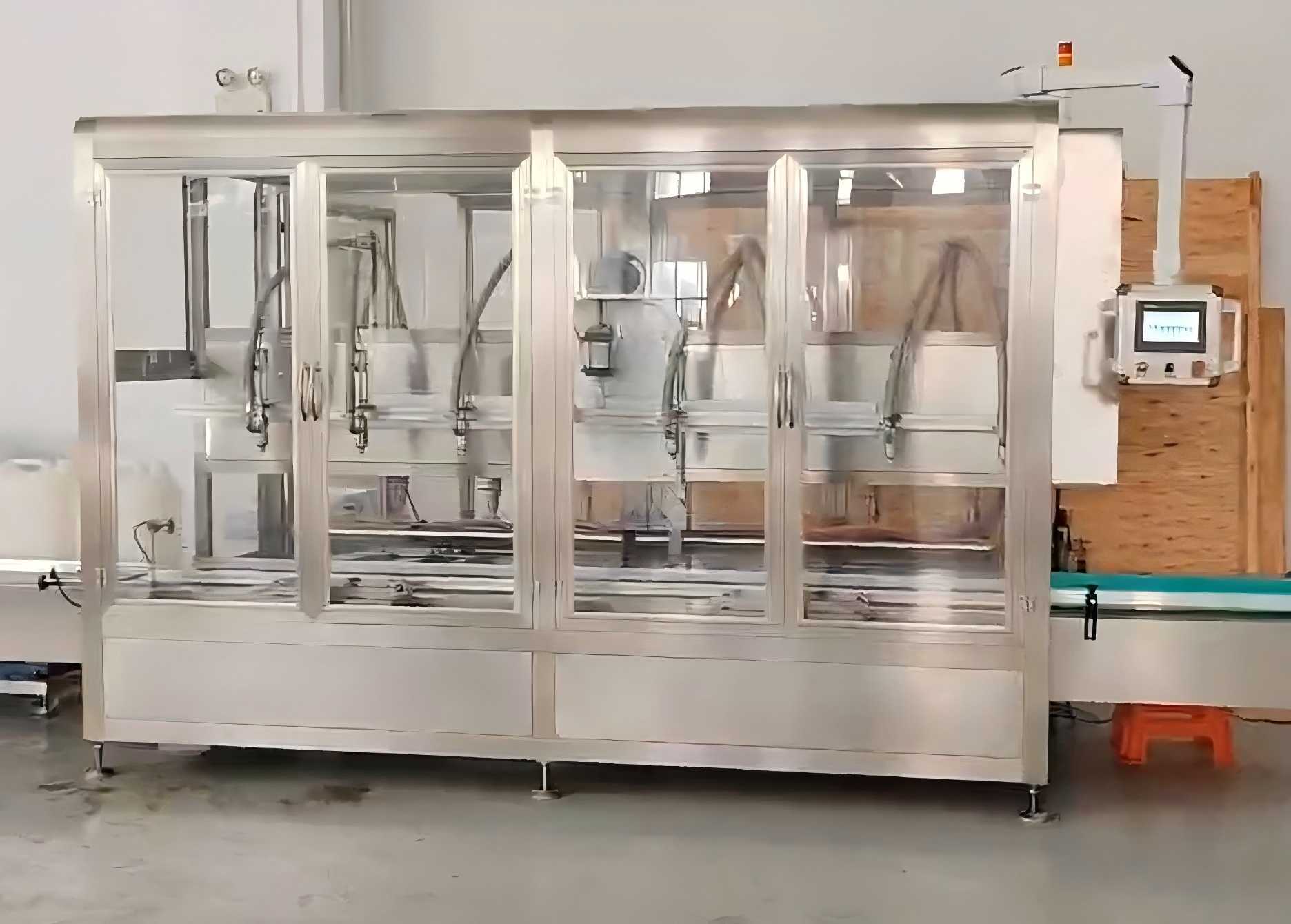
RUNTECH 20L chemical barrel weighing filling equipment
20L Chemical Barrel Automatic Weighing Filling Machine
This model is listed for weight-based filling of standard 20L chemical plastic and iron barrels, with a customizable 15–25 kg filling range. Its load-cell measurement and fast pre-filling followed by slow fine filling are relevant when the packaging specification is expressed in net kilograms rather than litres.
Its suitability should be assessed against the actual liquid, required net mass and intended barrel. The published figures alone do not replace an application-specific review.
The important question is not simply whether the machine is listed for a particular chemical category. It is whether the actual formulation can reach the required net mass within the available barrel volume and the confirmed equipment configuration.
Questions before the next step
Does a 20L barrel always contain 20 kg?
No. A 20L designation describes volume, not mass. The actual weight depends on the liquid’s density and the volume filled.
Is the 15–25 kg range fixed or customizable?
RUNTECH lists 15–25 kg and identifies the range as customizable. The required net mass and actual barrel should be confirmed before finalizing the configuration.
Does the published explosion-proof marking confirm suitability for every site?
Not necessarily. RUNTECH’s product page lists an explosion-proof designation of “Ex d II BT4,” but the published wording alone is not sufficient to confirm certification or suitability for a particular hazardous area. Before installation, qualified personnel should verify the equipment nameplate, applicable certificates, complete Ex marking and the site’s hazardous-area classification.
Confirm the filling weight against the actual barrel and material
If you’re evaluating this 20L weighing filler for a specific chemical product, start with the required net filling weight, measured liquid density, actual barrel dimensions and expected production conditions. These details will help RUNTECH review the filling configuration and identify what needs to be confirmed before quotation.
View Machine Details |
Discuss Your Application |